The question of the artificial states has recently been brought up by the referendum in Southern Sudan on whether the southern part of the country should declare political independence from the northern part of the country. An article in New York Times (link) succintly discussed few notable fact-checked evidence of the increasing ethnic, political and economic North-South division within the country. As a single country, Sudan performed terribly in development outcomes. According to CIA World Factbook (link), the country suffers from high rates of extreme poverty and illiteracy. For instance, the official share of population below poverty line is estimated at 40 percent - almost twice the average of North African states. In addition to poor development outcomes, the country is plagued by significant political and ethnic fragmentation into largely Muslim, Arab-speaking north and predominantly Christain, English-speaking south. The political independence of South Sudan is the only contemporary evidence of the re-establishment of land borders alongside the ethnic division.
In the recent paper entitled Artificial States, Alberto Alesina, William Easterly and Janina Matuszeski presented two formal measures of artificial states. Aside from the measure of ethnic division, the authors constructed the measure of straightness of border lines. The hypothesis suggests that squiggly geographic border lines separate the states alongside the ethnic division. On the contrary, straight border lines suggest increase the probability of the emergence of artificial states plagued by ethnic and linguistic fractioning. The authors presented the empirical evidence, suggesting that fractional land borders are highly correlated with the GDP per capita. In addition, the share of ethnically partitioned population within the country is systematically decreasing the GDP per capita in cross-country comparison. The intuitive ideas behind the empirical evidence suggest that at the end of colonial period, colonizers that set straight borderlines between the emerging countries incured significant economic cost to newly formed African countries in terms of lost GDP. The evidence from Alesina-Easterly-Matuszeski study suggest that a 1 percentage point increase in the fraction of country's population belonging to groups partitioned by the border would decrease the GDP per capita by 1.3 percent. On the other hand, countries with squiggly geographic borderlines enjoy significantly higher GDP per capita.
The post-colonial period in Sudan was characterized by two civil wars which outbroke in 1972 and 1983. In 1956, Sudan gained the political independence from Great Britain. Contemporary borderlines were predominantly determined by the colonial authorities in African states prior to the wave of independence of many African nations. The emergence of the artificial states is rather a consequence of poor colonial policies than of high bargaining cost of ethnic groups within the country in setting country borderlines. Hence, the economic effects of colonial legacy can persist over time. Consider the evidence from Cameroon. The country was originally colonized by Germany. During the World War I, Northern Cameroon was occupied by Germany while the rest of the country was colonized by the French. Between 1916 and 1960, the country was a unique experiment of how the establishment of the institutional setting of European countries affects domestic development outcomes. A recent study by Alexander Lee and Kenneth Schultz (link) suggests that in the areas formerly occupied by the British enjoy higher levels of wealth and improved access to clean water while the rest of the rural country, after having been colonized by the French, suffers from significantly hindered access to clean water and worse provision of public goods. Even though the colonial patterns do not apply to urban areas, lessons from Cameroon suggest that the impact of post-independence public policies and colonial legacy on the level of wealth is of the same importance even when linguistic and ethnic fragmentation persists over time.
In spite of considerable degree of inefficiency, the persistence of inefficient and ethnically fragmented states is continuously marked by poor economic and development outcomes, often accompanied by civil-war conflicts such as military violence and genocide by the Sudanese army in Darfur. An interesting theory has been recently put forth by Daron Acemoglu, Davide Ticchi and Andrea Vindigni (link) who suggest that rich political elites seize state capture and democratic politics by expanding the size of bureaucracy. Hence, to gain political support, the coalition of elites chooses an inefficient structure and organization of the state.
The phenomenon of artificial states is not abridged to least-developed countries and developing world. Even in the group of advanced countries, several countries emerged despite a considerable degree of linguistic, ethnic and cultural fractioning within country borders. The evidence from Switzerland suggests that a continuous transition to a peaceful and stable democracy is possible. Amid highly fragmented linguistic and cultural characteristics such as four official languages and the persistence of GDP per capita divergence between high-income German cantons and low-income French cantons, Switzerland is characterized by envious political stability and economic performance. The genuine feature of federal political system is a consistent fiscal decentralization such as jurisdictional competition between units within the federalized structure in various areas such as taxation, regulation, health care etc. Hence, a decentralized fiscal structure and division of powers require a limited federal government and a high degree of autonomy within the federation. Thus, despite a multilingual population, the Swiss model of federalism is marked by political stability, peace and prosperity.
The phenomenon of artificial states in advanced countries is not confined to Switzerland itself. What distinguishes the Swiss model of federalism from centralist political systems in its neighboring countries is a high degree of political autonomy in Swiss cantons. Competition between jurisdictions within the federation nonetheless generates different economic outcomes. However, the outcomes generated by jurisdictional competition preclude adverse effects caused by either state capture of democratic politics or redistributive taxation between jurisdictions. In Switzerland, cantons with favorable public policies such as low tax rates on labor and capital, sound regulation and competitive provision of health care, have enjoyed persistently higher levels of wealth compared to cantons in the rest of the country. Of course, the coexistence of diverse ethnic and lingual groups within the single state requires common values, integrated into formal institutions.
Contrary to common perception, the artificial state may not be characterized exclusively by ethnic and linguistic fragmentation. To a large extent, Germany and Belgium could be classifed as artificial states. In Belgium, Flemmish-speaking north of the country consistently outperformed French-speaking south on various indicators and outcomes, including income per capita, international test scores and employment-to-population ratio. The political and linguistic division of Belgium into high-income Flemmish part and less developed French part reflects the essential dilemma of artificial states - should a single country with fragmented and heterogenous population be abandonded and whether ethnicity borders should represent country borderlines. In fact, linguistic fragmentation of Belgium to the extent that Flemmish and French part of the country adopted different administrative and education systems, led to persistent inability of two majorities to form a government. In 2007, The Economist opined that Belgium should cease to exist. The unification of Germany (Wiedervereinigung) integrated two parts of the country with vastly different institutional setting into a single political unity. However, Eastern and Western Germany were known for completely different political and economic system. The unification has incured many adverse effects. A significant difference in wage and price levels between East Germany and West Germany caused continuous migration of East German labor into West Germany, thus decreasing the productivity growth in East Germany. Consequently, the unification of the country led to the adoption of West Germany level of prices and wages in Eastern part of the new country. The artificial increase in price-wage level increased the unemployment rate in Eastern Germany to double-digit level, not least triggered brain-drain and capital flight. Hence, the unification of Germany as an artificial state resulted in persistent income per capita divergence between high-income West Germany and low-income East Germany. The unification of Germany into a single country should indeed never happen. In fact, adverse effects of the unification on East German productivity and wages would not lead to continuous increase in unemployment rate. If East Germany maintained a high degree of political autonomy, the transition to market economy would not be restrained by the adoption of West German price-wage level that could not be sustained by low productivity level in East Germany. To avoid the pitfalls of the artificial states, West and East Germany would be better off, had the countries never been reunified.
Recent national referendum in South Sudan on whether the southern part of the country should declare political independence from Sudan again pondered over the persistence of artificial states. The empirical evidence on poor development outcomes in several African countries suggests that borderlines, disregarding the ethnic distribution of the population within the country, are highly correlated with low income per capita. The unique solution of the artificial states is the adoption of political federalism. Under fiscal decentralization and limited government, federalism enables peaceful and prosperous existence of fragmented ethnic and linguistic structure in a single state. For instance, former Yugoslavia, known for highly fragmented ethnic, linguistic and economic disparities, ceased to exist not because federalism would not be a genuine political system but, ultimately, because of severe economic mismanagement, powerful and centralized government that disdained the principles of political autonomy and market economy, causing severe hyperinflation and the collapse of the federation that eventually resulted in a decade of civil wars and military violence. The evidence from Yugoslavia suggests that between 1950 and 1990, drastic economic divergence occured. The lesson suggests that the essential condition for the efficiency of federalism as a political system is high political autonomy and fiscal decentralization, both of which enable the competition between public policies.
Amid linguistic fragmentation, the competition between jurisidictions rewards competitive public policies by higher income per capita which ultimately boost the inception of public policies in less developed parts of the federation. Hence, without jurisdictional competition and political autonomy, ethnic and linguistic fragmention of the country may ultimately result in political instability which, in addition, generates poor economic outcomes.
Showing posts with label Political Economy. Show all posts
Showing posts with label Political Economy. Show all posts
Wednesday, January 12, 2011

Friday, September 3, 2010
AUTHORITARIAN POLITICS AND ECONOMIC GROWTH
Dani Rodrik argues (link) that political dictatorship is damaging to economic growth since democracies not only outperformed countries with flawed political regimes in the dynamics of economic growth but also in terms of greater civil, economic and political liberties and investment in education that help enforce better public policies and yield better prospects of economic development.
"Democracies not only out-perform dictatorships when it comes to long-term economic growth, but also outdo them in several other important respects. They provide much greater economic stability, measured by the ups and downs of the business cycle. They are better at adjusting to external economic shocks (such as terms-of-trade declines or sudden stops in capital inflows). They generate more investment in human capital – health and education. And they produce more equitable societies."
"Democracies not only out-perform dictatorships when it comes to long-term economic growth, but also outdo them in several other important respects. They provide much greater economic stability, measured by the ups and downs of the business cycle. They are better at adjusting to external economic shocks (such as terms-of-trade declines or sudden stops in capital inflows). They generate more investment in human capital – health and education. And they produce more equitable societies."
Thursday, July 15, 2010
POVERTY, INCOME INEQUALITY AND ECONOMIC DEVELOPMENT
Financial Times reports (link) on the new measure of poverty proposed by economists from Oxford University. The authors suggested the modification of current measure of poverty which, defined by the World Bank in annually published World Development Report, is currently set at the thresold of $1.25 per day or less. The new measure proposed by economic researchers from Oxford University sets the definition of poverty in a more sophisticated framework based on the household availibility of access to clean water, education, health care and other durable and non-durable goods. The new method, called Alkire-Foster approach, incorporates the qualitative elements into the measurement of poverty.
Using the new method, the authors examined poverty rates in four Indian provinces and evaluated the approach in comparison to the existing income method which had been used in economic and policy analysis by the World Bank and other institutions of economic development. The authors found a significant divergence of poverty rates when measured in both methods. For instance, under Alkire-Foster approach, the poverty rate in Indian state Jharkhand is 50 percent higher compared to the rate of poverty measured under the income method. On the other hand, the authors of the new poverty measure have shown that in some Indian provinces such as Uttaranchal (link), the official measure of poverty highly over-estimates the effective poverty measure as defined by Oxford's Poverty and Human Development Initiative. The multidimensional worldwide poverty index is also availible on the web (link).
The intuitive question arising from the data and empirical research on poverty is whether higher economic growth in less developed countries boosts the growth of income per capita and what is the role of institutional characteristics in economic development. The authors of the abovementioned measure of poverty have shown that despite abundant economic growth in past years and falling income poverty rates, the share of population without access to clean water, sanitation and minimum required nutrition remained unchanged. The percentage of malnourished children in India decreased from 47 percent in 1998-98 to 46 percent 2005-06.
The theoretical and empirical literature on economic growth suggests that there is an inverse U-relationship between inequality and income per capita known as Kuznets curve (link). The intuition behind the relationship is simple. At the very low levels of income per capita, income inequality is low. Alongside the course of growing income per capita, income inequality steeply increases and, after reaching a maximum, it decreases as countries achieve higher levels of income per capita. The rate of income inequality is closely related to the evolution of economic policies over time. Wagner's law, discussed in one of the previous posts, states that government spending over time increases due to long-run income elastic demand for public goods and capture of the democratic system by the particular interest groups that pose a permanent pressure on the growth of government spending and resist the reversals of government expenditures by trading votes.
There's a wide array of disagreement among economists on the effect of income inequality on economic growth. Back in 2001, Joseph Stiglitz re-examined the East Asian economic miracle and concluded that the evidence from the period of high economic growth in East Asian countries suggests that income redistribution has a positive effect on economic growth (link). Stiglitz's argument is based on the income distribution in East Asian countries during the economic miracle. East Asian countries have been known for relatively even distribution of income demonstrated by high Gini index and relatively high income tax rates.
On the other hand, the empirical investigation of the initial conditions in East Asian countries before the economic miracle shows that the political influence of interest groups had been relatively weak compared to Western Europe after the World War 2 when the productivity growth stalled from early 1970s onwards. The relative weakness of interest groups and a stable judicial system, inherited from English common law tradition, enabled high economic growth in the longer run given an enduring stability of property rights protection and the rule of law. In such conditions, income redistribution had relatively little effect on economic growth since the empirics of East Asian miracle suggests that the sizeable proportion of growth in East Asian countries (Malaysia, Singapore, Korea and Taiwan) had been driven by technological progress, investment and export orientation. Considering export orientation, Rodrik et. al (2005) provided the evidence (link) on the positive effect of high-quality export orientation on economic growth. The productivity growth in East Asian countries between 1975 and 1990 had been a pure example of economic miracle defined by the share of growth that could not be explained by the contribution of labor and capital input. In Taiwan and Hong Kong (link), total factor productivity accounted for about 60 percent of output per capita growth. Between 1975 and 1990, in Singapore, output per capita had increased by 8.0 percent. Consequently, the resulting outcome of almost two decades of robust productivity growth had been a significant decrease in national poverty rates (link). The lowest poverty rate, as defined by the measures of home authorities, is in Taiwan where 0.95 of the population live below the poverty thresold.
The basic set of policies that alleviate extreme poverty such as providing access to clean water, nutrition, medical protection against HIV/AIDS and basic sanitary standards have a positive effect on the economic growth and the standard of living. However, the major cause of persistent under-development in Subsaharan and Tropical Africa is mostly the lack of institutional enforcement of property rights, the rule of law and independent judiciary. In spite of billions of USD of direct foreign aid, countries such as Zambia, Sierra Leone, Mali and Rwanda endure in persistent poverty and under-development. Esther Duflo, this year's recepient of John Bates Clark Award, has shown in several studies how field experiments can enlighten the understanding of incentives in least developed countries (link). Understanding the significance of incentives in reducing poverty is crucial to further examination of the relationship betwen income inequality and economic growth.
Using the new method, the authors examined poverty rates in four Indian provinces and evaluated the approach in comparison to the existing income method which had been used in economic and policy analysis by the World Bank and other institutions of economic development. The authors found a significant divergence of poverty rates when measured in both methods. For instance, under Alkire-Foster approach, the poverty rate in Indian state Jharkhand is 50 percent higher compared to the rate of poverty measured under the income method. On the other hand, the authors of the new poverty measure have shown that in some Indian provinces such as Uttaranchal (link), the official measure of poverty highly over-estimates the effective poverty measure as defined by Oxford's Poverty and Human Development Initiative. The multidimensional worldwide poverty index is also availible on the web (link).

The intuitive question arising from the data and empirical research on poverty is whether higher economic growth in less developed countries boosts the growth of income per capita and what is the role of institutional characteristics in economic development. The authors of the abovementioned measure of poverty have shown that despite abundant economic growth in past years and falling income poverty rates, the share of population without access to clean water, sanitation and minimum required nutrition remained unchanged. The percentage of malnourished children in India decreased from 47 percent in 1998-98 to 46 percent 2005-06.
The theoretical and empirical literature on economic growth suggests that there is an inverse U-relationship between inequality and income per capita known as Kuznets curve (link). The intuition behind the relationship is simple. At the very low levels of income per capita, income inequality is low. Alongside the course of growing income per capita, income inequality steeply increases and, after reaching a maximum, it decreases as countries achieve higher levels of income per capita. The rate of income inequality is closely related to the evolution of economic policies over time. Wagner's law, discussed in one of the previous posts, states that government spending over time increases due to long-run income elastic demand for public goods and capture of the democratic system by the particular interest groups that pose a permanent pressure on the growth of government spending and resist the reversals of government expenditures by trading votes.
There's a wide array of disagreement among economists on the effect of income inequality on economic growth. Back in 2001, Joseph Stiglitz re-examined the East Asian economic miracle and concluded that the evidence from the period of high economic growth in East Asian countries suggests that income redistribution has a positive effect on economic growth (link). Stiglitz's argument is based on the income distribution in East Asian countries during the economic miracle. East Asian countries have been known for relatively even distribution of income demonstrated by high Gini index and relatively high income tax rates.
On the other hand, the empirical investigation of the initial conditions in East Asian countries before the economic miracle shows that the political influence of interest groups had been relatively weak compared to Western Europe after the World War 2 when the productivity growth stalled from early 1970s onwards. The relative weakness of interest groups and a stable judicial system, inherited from English common law tradition, enabled high economic growth in the longer run given an enduring stability of property rights protection and the rule of law. In such conditions, income redistribution had relatively little effect on economic growth since the empirics of East Asian miracle suggests that the sizeable proportion of growth in East Asian countries (Malaysia, Singapore, Korea and Taiwan) had been driven by technological progress, investment and export orientation. Considering export orientation, Rodrik et. al (2005) provided the evidence (link) on the positive effect of high-quality export orientation on economic growth. The productivity growth in East Asian countries between 1975 and 1990 had been a pure example of economic miracle defined by the share of growth that could not be explained by the contribution of labor and capital input. In Taiwan and Hong Kong (link), total factor productivity accounted for about 60 percent of output per capita growth. Between 1975 and 1990, in Singapore, output per capita had increased by 8.0 percent. Consequently, the resulting outcome of almost two decades of robust productivity growth had been a significant decrease in national poverty rates (link). The lowest poverty rate, as defined by the measures of home authorities, is in Taiwan where 0.95 of the population live below the poverty thresold.
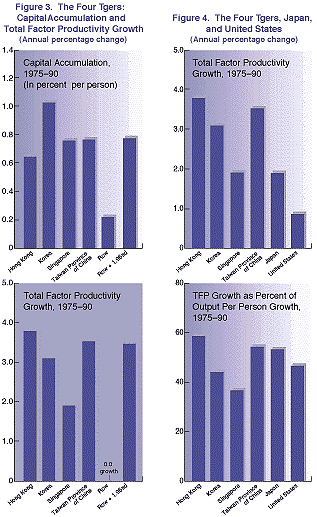
The basic set of policies that alleviate extreme poverty such as providing access to clean water, nutrition, medical protection against HIV/AIDS and basic sanitary standards have a positive effect on the economic growth and the standard of living. However, the major cause of persistent under-development in Subsaharan and Tropical Africa is mostly the lack of institutional enforcement of property rights, the rule of law and independent judiciary. In spite of billions of USD of direct foreign aid, countries such as Zambia, Sierra Leone, Mali and Rwanda endure in persistent poverty and under-development. Esther Duflo, this year's recepient of John Bates Clark Award, has shown in several studies how field experiments can enlighten the understanding of incentives in least developed countries (link). Understanding the significance of incentives in reducing poverty is crucial to further examination of the relationship betwen income inequality and economic growth.
Sunday, January 17, 2010
Economic growth and democratic institutions
Professor William Easterly recently presented (link) an intriguing empirical evidence on the relationship between nation's politics and economic growth. In particular, professor Easterly presented data on long-run economic growth and the scope of democracy for a majority of countries between 1960 and 2008. Professor Easterly identified that the highest-growing countries in the world were those with autocratic political regimes. Among ten highest-growing economies between 1960 and 2008, all of them, except for Cyprus, have been characterized by hybrid and autocratic political regimes. On the other hand, ten countries with the lowest growth rates of real GDP per capita between 1960 and 2008 were equally known for authocratic political systems or flawed democracies.
Presumably, the evidence bodes against the recent prediction by Dani Rodrik that authoritarian political regimes ultimately create economic systems vulnerable to external shocks and structural change, thus hampering the prospects of structural change as a neccessary condition for economic development.
To estimate the general pattern of the relationship between economic growth and the nature of political system, I reviewed real per capita GDP growth rates between 1970 and 2007 for a group of 134 countries across the broad spectrum of different levels of GDP per capita. Based on Summers-Heston dataset of real GDP per capita growth rates (link) between the stated time period, I estimated average rates of growth of GDP per capita and collected data from Economist Intelligence Unit on the level of democracy across the world in 2008 (link). The intuition behind this approach is the identification of endogenous and casual direction between the two variables. From the theoretical perspective, it is nonetheless difficult to establish a relationship between the form of government and long-run economic growth. There are at least two possible directions of casuality.
First, the underlying assumption of the relationship could be that systemic changes in political environment are essential to the structural change and, hence, are the main mechanism behind the enforcement of constitutional changes and public policies. The assertion of the underlying theory is that autocratic and authoritarian political system hinder structural changes and the establishment of institutions and democratic governance that is crucial for economic growth. This particular view has been asserted by Dani Rodrik (link), Andrei Shleifer, Florencio Lopez de Silanes and Rafael La Porta (link). While Dani Rodrik's perspective heavily relied on the importance of institutions for long-run economic growth, Shleifer, Lopez de Silanes & La Porta captured the essence of economic development in the legal origins of nations.
Second, the casuality in economic growth and political system could also stem in the opposite direction. The basic underlying assumption could be that higher rates of economic growth encourage systemic changes in the political system and enable the adoption of democratic institutions. The notion of economic growth as the engine of democratic changes has deserved a strong empirical support.
Robert Barro's analysis of long-run economic growth across the world (link) has examined the relationship between the level of democracy and long-run economic growth rate. The empirical evidence suggests a non-linear, inverted-U relationship between democracy and 10-year growth residuals, both coefficients in partial quadratic equation and the partial correlation coefficient being statistically significantly different from zero.
The notion would suggest that as countries depart from a low level of real GDP per capita, the adoption of democratic institutions accelerates economic growth but only up to some point. After the tipping point, the economic outcome of further democratization results in lower growth of real GDP per capita, partly because a high level of democracy tends to promote public policies that diminish growth prospects such as higher tax rates on labor and capital and the redistribution of income, all of which exert a somewhat negative effect on productivity growth and incentives for labor supply and investment.
The first table portrays the distribution of real per capita GDP growth rates across 134 countries between 1970 and 2007. The distributive pattern resembles the properties of normal distribution curves. In fact, the estimated coefficients of skewness and kurtosis suggest a rather very mild departure from the assumption of normality which is of the high importance, especially in testing hypotheses about the effects of explanatory variables on long-run growth dynamics. The normality assumption of normally distributed errors was not tested via normality tests.
Ten highest growing countries in terms of real GDP per capita between 1970 and 2007 are Equatorial Guinea (8.39 percent), Taiwan (5.98 percent), China (5.97 percent), St. Kitts & Nevis (5.49 percent), Botswana (5.45 percent), Bhutan (5.38 percent), Maldives (5.38 percent), Hong Kong (5.37 percent), Macao (5.30 percent) and Singapore (5.29 percent). In real terms, the estimated average real per capita GDP growth rates suggest that it took only 13 years for Singapore's real GDP per capita to double and 21 years to triple. In China, where the estimated average growth rate exceeded Singapore's growth rate only by 0.69 percentage point, it took roughly 11 years for real GDP per capita to double and only 19 years to triple. In the lower tail of growth distribution are mostly countries from Sub-Saharan Africa such as Democratic Republic of Congo, Liberia, Somalia, Central African Republic and Niger. Average real growth rates of GDP per capita of these countries were negative. The negative average real GDP per capita growth rate occured in 11 percent of country observations.
Distribution of economic growth across 134 countries between 1970 and 2007Presumably, the evidence bodes against the recent prediction by Dani Rodrik that authoritarian political regimes ultimately create economic systems vulnerable to external shocks and structural change, thus hampering the prospects of structural change as a neccessary condition for economic development.
To estimate the general pattern of the relationship between economic growth and the nature of political system, I reviewed real per capita GDP growth rates between 1970 and 2007 for a group of 134 countries across the broad spectrum of different levels of GDP per capita. Based on Summers-Heston dataset of real GDP per capita growth rates (link) between the stated time period, I estimated average rates of growth of GDP per capita and collected data from Economist Intelligence Unit on the level of democracy across the world in 2008 (link). The intuition behind this approach is the identification of endogenous and casual direction between the two variables. From the theoretical perspective, it is nonetheless difficult to establish a relationship between the form of government and long-run economic growth. There are at least two possible directions of casuality.
First, the underlying assumption of the relationship could be that systemic changes in political environment are essential to the structural change and, hence, are the main mechanism behind the enforcement of constitutional changes and public policies. The assertion of the underlying theory is that autocratic and authoritarian political system hinder structural changes and the establishment of institutions and democratic governance that is crucial for economic growth. This particular view has been asserted by Dani Rodrik (link), Andrei Shleifer, Florencio Lopez de Silanes and Rafael La Porta (link). While Dani Rodrik's perspective heavily relied on the importance of institutions for long-run economic growth, Shleifer, Lopez de Silanes & La Porta captured the essence of economic development in the legal origins of nations.
Second, the casuality in economic growth and political system could also stem in the opposite direction. The basic underlying assumption could be that higher rates of economic growth encourage systemic changes in the political system and enable the adoption of democratic institutions. The notion of economic growth as the engine of democratic changes has deserved a strong empirical support.
Robert Barro's analysis of long-run economic growth across the world (link) has examined the relationship between the level of democracy and long-run economic growth rate. The empirical evidence suggests a non-linear, inverted-U relationship between democracy and 10-year growth residuals, both coefficients in partial quadratic equation and the partial correlation coefficient being statistically significantly different from zero.
The notion would suggest that as countries depart from a low level of real GDP per capita, the adoption of democratic institutions accelerates economic growth but only up to some point. After the tipping point, the economic outcome of further democratization results in lower growth of real GDP per capita, partly because a high level of democracy tends to promote public policies that diminish growth prospects such as higher tax rates on labor and capital and the redistribution of income, all of which exert a somewhat negative effect on productivity growth and incentives for labor supply and investment.
The first table portrays the distribution of real per capita GDP growth rates across 134 countries between 1970 and 2007. The distributive pattern resembles the properties of normal distribution curves. In fact, the estimated coefficients of skewness and kurtosis suggest a rather very mild departure from the assumption of normality which is of the high importance, especially in testing hypotheses about the effects of explanatory variables on long-run growth dynamics. The normality assumption of normally distributed errors was not tested via normality tests.
Ten highest growing countries in terms of real GDP per capita between 1970 and 2007 are Equatorial Guinea (8.39 percent), Taiwan (5.98 percent), China (5.97 percent), St. Kitts & Nevis (5.49 percent), Botswana (5.45 percent), Bhutan (5.38 percent), Maldives (5.38 percent), Hong Kong (5.37 percent), Macao (5.30 percent) and Singapore (5.29 percent). In real terms, the estimated average real per capita GDP growth rates suggest that it took only 13 years for Singapore's real GDP per capita to double and 21 years to triple. In China, where the estimated average growth rate exceeded Singapore's growth rate only by 0.69 percentage point, it took roughly 11 years for real GDP per capita to double and only 19 years to triple. In the lower tail of growth distribution are mostly countries from Sub-Saharan Africa such as Democratic Republic of Congo, Liberia, Somalia, Central African Republic and Niger. Average real growth rates of GDP per capita of these countries were negative. The negative average real GDP per capita growth rate occured in 11 percent of country observations.
 Source: own estimate based on Summers-Heston dataset
The following graph illustrates the relationship between long-run average growth rates and the level of democracy in 2008 for the entire sample of 134 countries. The attempt to analyze the effect of democracy level on long-run economic growth is based on the notion that democratic institutions elevate economic growth in the longer run. The estimated slope coefficient (0.2277) suggest that a one-point increase in democracy index increases the average long-run per capita GDP growth rate by 0.2277 percentage point controlling for other factors.
Although the cross-country variation in the level of democracy explains only about 9 percent of growth rate variance, and even though the direct effect of democracy on economic growth seems minor and almost non-existent, the estimated sample regression coefficient is statistically significant at 5 percent level. It suggests that the effect of democracy on growth is persistant and evident in the particular sample.
Democracy and average long-run growth rates in a sample of 134 countries
 Source: own estimates
Hence, to account for different degree of variation in average real GDP per capita growth rates, I divided the sample into quartiles. The goal of the pursued empirical strategy is to see whether the difference in variance composition between countries with similar growth rates persists. I divided the total sample into four groups: high growth performers (average growth rate higher than 3 percent) moderate growth countries (average growth rate below 3 percent and above 2.05 percent) and low growth countries (average growth rate below 1.09 percent). The next graph shows the relationship between democracy and average real GDP per capita growth rate in high-growth countries between 1970 and 2007. The parameters suggests a different relationship. The estimated slope coefficient is negative (-0.1638), suggesting that a one point increase in democracy index decreases the average real GDP per capita growth rate by about 0.1638 percentage point.
The share of variance explained by the democracy variable increased by 22.5 percent. In the statistical sense, the effect of democracy on economic growth in high-growth countries has been more powerful compared to the total sample. The estimated slope coefficient is statistically significant at 5 percent level. I also estimated beta coefficient (-0.338) to account for the effects of standard deviation increase on the average growth rate in real GDP per capita. The estimated beta coefficient suggests that a one standard deviation increase in democracy level (2.4 points) would, on impact, decrease the average real GDP per capita growth rate by 0.338 standard deviation or 0.394 percentage point in real terms.
From a theoretical perspective, the enforcement of democratic policies in high-growth countries would have a minor negative effect on economic growth, holding all other factors constant. Surprisingly, authortarian regimes previal in 44 percent of countries in the high-growth sample. Thus, the hypothetically negative effect of democracy on economic growth is evident but it is far from significantly negative.
The share of variance explained by the democracy variable increased by 22.5 percent. In the statistical sense, the effect of democracy on economic growth in high-growth countries has been more powerful compared to the total sample. The estimated slope coefficient is statistically significant at 5 percent level. I also estimated beta coefficient (-0.338) to account for the effects of standard deviation increase on the average growth rate in real GDP per capita. The estimated beta coefficient suggests that a one standard deviation increase in democracy level (2.4 points) would, on impact, decrease the average real GDP per capita growth rate by 0.338 standard deviation or 0.394 percentage point in real terms.
From a theoretical perspective, the enforcement of democratic policies in high-growth countries would have a minor negative effect on economic growth, holding all other factors constant. Surprisingly, authortarian regimes previal in 44 percent of countries in the high-growth sample. Thus, the hypothetically negative effect of democracy on economic growth is evident but it is far from significantly negative.
Democracy and average long-run growth rates in high-growth countries
 Source: own estimates based on Summers-Heston and EIU datasets
The next graph portrays the relationship between democracy and average real GDP per capita growth rates in low-growth countries. Contrary to the sample estimate in high-growth country group, the effect of democracy on real GDP per capita growth rate is positive and persistent. The correlation coefficient is positive and moderate (0.458) and statistically significant at 1 percent level. The beta coefficient (0.458) from the regression specification suggests that a one standard deviation increase in democracy level (cca. 1.497 points) would raise the average real GDP per capita growth rate on impact by 0.458 standard deviation or 0.382 percentage point, ceteris paribus. In fact, the variability in level of democracy explains 21.1 percent of the variance of average per capita GDP real growth rates. The estimated slope coefficient is statistically significant at 2.1 percent level and 0.6 percent level, suggesting a very low probability of rejecting the null hypothesis and a strong influence of democratic institutions on economic growth in the long run.
Democracy and average long-run growth rates in low-growth countries
 Source: own estimate based on Summers-Heston and EIU datasets
In the next subsample, I jointly added high-growth and low-growth countries in the single sample and changed the casual direction. The underlying assumption is that democracy level is endogenously determined by the long-run average real GDP per capita growth rate. In real terms, I assumed that the public choice of political institutions across the world depend on the real GDP growth rate. Hence, I estimated the relationship by including the squared term in the regression equation. The estimated slope coefficients suggest a typical inverted-U relationship between real GDP per capita growth rate and the level of democracy. The real GDP per capita growth rate alone explains 30.6 percent of the cross-country variaton in the level of democracy. Intuitively, the results suggest that there exists an optimum level of real GDP per capita growth that maximizes the level of institutional democracy.
Differentiating the conditional expectation function of the level of democracy with respect to the real GDP per capita growth rate yields the partial derivate dy/dx = -(ß2/2ß3). Plugging the two coefficients in the partial derivate yields 3.65. Thus, the growth rate of real GDP per capita that maximizes the level of institutional democracy is 3.65 percent. Hence, both coefficients are statistically significant. The p-values are 0.000 suggesting a zero probability of rejecting a null hypothesis when it is, in fact, true - and a strong predictive influence of both variables on the expected level of democracy.
The effect of long-run economic growth on democratic institutions in high-growth and low-growth countries
 Source: own estimates based on Summers-Heston and EIU datasets
Countries with the comparable growth rate are Iceland, Ireland, Trinidad & Tobago and Spain. Except for Trinidad & Tobago, none of these countries is either flawed democracy or an authoritarin political regime. Therefore, the expected level of democracy is low in countries where the average growth rate of GDP per capita is either very low or negative or very high.
Hypothetically, the conditional pattern of real per capita GDP growth supports the notion that the highest-growing countries in the 20th century such as Singapore, Taiwan and Botswana had a relatively low level of democracy and a significant degree of political authoritarianism. In addition, countries with the lowest growth rate of real GDP per capita such as Liberia, Sierra Leone and Somalia were also authoritarian political regimes. The predictive power of the regression equation is reasonably high since more than 30 percent of the variance of the level of democracy is explained by a non-linear shifts in the long-run average real GDP per capita growth rate.
Democracy is a controversial question of the modern theory of economic growth. Indeed, the empirical evidence suggests that the highest growth rates were achieved in those countries with a considerable degree of political dictatorship. However, the lowest long-run growth rates of real GDP per capita were achieved by countries in which political dictatorship prevails. The pattern suggest that the quality of institutions such as the rule of law, judicial independence and a constitutional democracy complement the significance of human capital which is the essential engine of long-run economic growth.
The most important growth engine of the highest growing countries such as East Asian tigers and Ireland has been the emphasize on human capital that resulted in a high level of knowledge intensity and high productivity growth rate. These countries were known for heavy doses of state interventionism aimed towards the implementation of industrial policy conducive to economic growth. However, the conclusion should be taken with caution. Political dictatorship or authoritarianism were detrimental to least-developed countries since it encouraged predatory political behavior and resulted in the political environment with a complete absence of the rule of law, judicial independence, protection of private property rights, institutional integrity and constitutional democracy.
The question which set of growth policies is essential to high long-run growth of real GDP per capita involves two answers. First, the primacy of institutional quality alongside the investment in human capital is by far the most important engine of long-run economic growth. Without first-class institutions and human capital, the vicious circle of poverty and social deprivation for less developed nations can be endless. And second, the components of constitutional democracy such as electoral rights and pluralism, good functioning of government, high level of political culture and civil liberties can deliberately increase the prospects of economic growth.
However, if the power of state is left unrestrained by the absence of the rule of law and a coherent set of checks and balances on the coercive strenght of redistributive interest groups, even a high level of democracy would not alleviate the persistence of poverty and weak structural indicators. On the contrary, it would only worsen the prospects of long-run economic growth.
Subscribe to:
Posts (Atom)